Privacy in Retail AI: What’s Ethical, Legal, and Possible
- Benny Lauwers

- Nov 3, 2025
- 3 min read
When retailers hear AI and cameras in the same sentence, the first reaction is often the same:
“That’s not legal.”
But here’s the truth: it actually is, if done right.
Modern AI in retail doesn’t have to watch people. It can understand spaces.
From Surveillance to Sensemaking
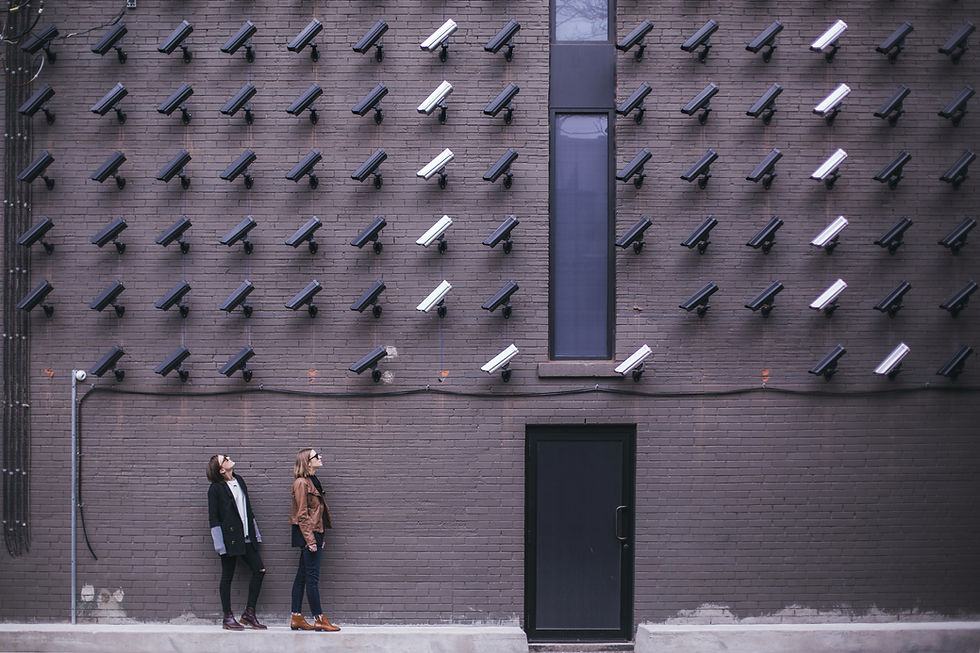
For decades, in-store cameras had one job: security.
They observed, recorded, and occasionally helped reconstruct what went wrong.
Today, that same infrastructure is being reimagined.
Thanks to computer vision and privacy-by-design AI, cameras can now detect movement patterns, measure dwell time, and analyze engagement. Without ever knowing who anyone is.
The difference lies in intent and design.
Surveillance asks:
“Who is that?”
In-store intelligence asks:
“What’s happening?”
One looks for faces.
The other looks for patterns.
And that distinction changes everything. Legally, ethically, and commercially.
What AI Actually Sees
Forget the idea of identity recognition.
Modern retail analytics models don’t see people as individuals.
They see motion, duration, and direction.
Each person becomes an anonymous trace, a series of coordinates that represent movement through space.
No facial recognition.
No biometric data.
No link to personal identity.
It’s data without identity. Pure behavioral signal.
That’s how the same cameras that once only recorded footage can now provide compliant, actionable insight.
The GDPR Lens: What’s Allowed
Europe’s GDPR doesn’t ban camera analytics or AI.
It simply defines how they must be used.
The foundation is privacy by design: collect only what you need and never make it personally identifiable.
A responsible retail analytics pipeline should:
Avoid facial recognition or biometric ID
Work with anonymized silhouettes or tracks
Delete or aggregate data rapidly after analysis
Operate under GDPR Article 6(1)(f) — legitimate interest for operational improvement
When these principles are followed, retailers can legally use AI to understand behavior, optimize operations, and improve experience, without breaching privacy.
The Ethics of Understanding, Not Watching
The real question isn’t whether AI can see. It’s how it sees.
Ethical AI shifts the focus from identification to interpretation: understanding how people move, where they pause, what attracts attention... All without intruding on who they are.
This approach respects the balance between commercial insight and human dignity.
It allows stores to evolve intelligently, not invasively.
It’s visibility with responsibility.
Why Privacy-First AI Is Better for Everyone
When data collection respects boundaries, trust follows.
Customers feel safer. Employees feel protected. And retailers gain insights they can actually defend and explain.
It’s also better business.
Because privacy-compliant analytics are scalable. They can be rolled out across networks and countries without legal friction.
In other words: doing it right is a competitive advantage.
Storalytic’s Perspective
At Storalytic, every analytic pipeline follows these principles from the ground up.
Our models analyze behaviour, not identity.
We translate camera data into anonymous movement patterns like visitors, dwell times, engagement funnels, ... Never into personal profiles.
All inference happens locally.
Footage never leaves the store. Only aggregated, anonymized insights are processed and visualized.
That’s how we give retailers the intelligence they need while ensuring shoppers keep their privacy intact.
It’s AI that sees responsibly.
Closing Thought - The New Standard: Privacy by Design
The debate around AI and privacy shouldn’t be about fear. It should be about framework.
When done responsibly, AI becomes an ally of transparency, not a threat to it.
It helps retailers understand their spaces, improve experiences, and optimize layouts. All while staying within both the letter and the spirit of GDPR.
The question isn’t “Can AI see in stores?”
It’s “Can AI see responsibly?”
The answer is yes.
And it’s already happening.
Read more → AI and Computer Vision in Retail